Monday, August 23, 2010


I had posted a few months ago that Polaroid was going to start making instant film again, but it was not the kind of film I was hoping to use. It was for their 300 product, which does not work in the SX-70 or 600 series cameras.

Meanwhile, The Impossible Project (which I'll call "TIP" from here on out) has rescued a Polaroid plant in Enschede, Netherlands, from destruction and has been starting to make film for old Polaroid cameras, and have recently released a color version of their film that works in the SX-70, and can be made to work in 600 series cameras with a little light-sensor trickery. A 600-series color film is in the works, according to TIP.

I have put a few pictures here in small sizes, but you can see all my trials with the TIP film on my Flickr page. If you are looking at this blog post much after August 2010, look in my set "Impossible Project/Polaroid."



I ordered 3 packs of the PX 70 Color Shade/First Flush film for the SX-70, and one pack of PX 600 Silver Shade film. Each pack contains 8 exposures. I have to hand it to TIP: They got the film to me in just three days! And even though they are still building the film packs using the remaining stock of Polaroid batteries, the packs I've used so far are functioning fine. I understand that they plan to start making new battery packs at some point.

So far, I have gone through the Silver Shade and one and a half of the Color Shade packs. And it's been a little bit of a fun learning experience for me, because unlike my fantastic, does-everything DSLR, I am once again forced to think about exposure more critically. The Polaroid also has a fixed, short telephoto lens on it, and the format is nearly square, which is different than what I been accustomed to with my DSLR. I also put a restriction on myself that I would not be tempted to digitally alter the photos, even just fixing basic stuff like straightening crooked horizons.

The first film I tried in my daughter's cast off Polaroid OneStep Express was the PX 600 Silver Shade. Despite its name, the pictures come out with a dark sepia toning, which lends kind of an eerie, ghostly look to the photos. I really like this look.
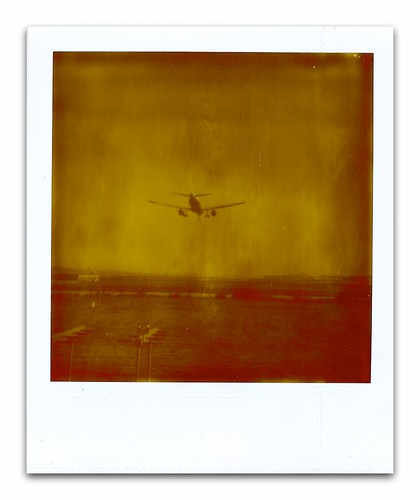


Here are some shots of using the PX 600 Silver Shade and the OneStep Express.
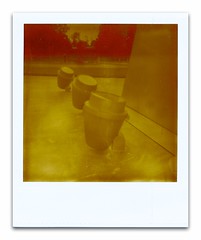
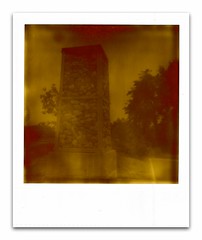


The film, being somewhat experimental, has imperfections, but I prefer to think of them as "character traits." Each picture seems to be unique in where and how the imperfections appear. Sometimes there are small individual white dots, other times they are patches of red dots in the shadow areas, and in one instance, a huge blob of something in the emulsion. And the chemicals in the film do not appear to be spread evenly by the camera's ejection rollers, at least in my first pack of Silver Shade. You can see dark bands around the perimeter of the photos where the camera'a ejector rollers apply less pressure to the emulsion due to the extra thickness of the white border layers. The color shots from the PX 70 film seem to have a more even application of the chemistry, but they still show some darkness at the edges, particularly in the underexposed shots. All in all, I still think it gives the pictures an interesting feel.

Then I moved on to the PX 70 Color Shade in the OneStep Express. The PX 70 film is rated at ISO 125, and the camera is designed for ISO 640, causing the shots come out underexposed by about 2 or 3 stops even with the camera set to maximum overexposure, which is limited to a change from normal of about 1.5 stops. So further trickery would have to be done by partially covering the light sensor on the front of the camera with some electrical tape or similar. I tried putting my finger over the entire sensor and got a large amount of overexposure, with the picture becoming extremely washed out.
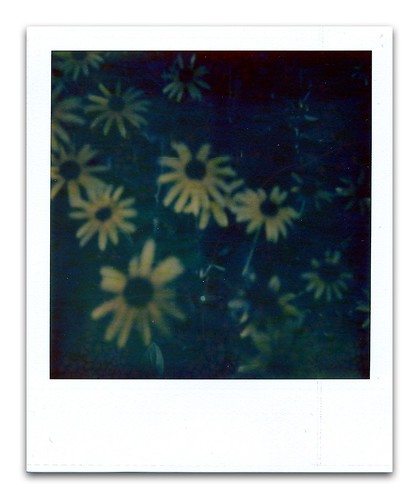


Now, one thing about the PX 70 Color Shade film: It is extremely sensitive to light as it is ejected from the camera, unlike the Polaroid films. For whatever reason, the Silver Shade is not quite so sensitive as the Color Shade. It's not that the Silver Shade is perfect, though. It is wildly sensitive to temperature during development, which can be highly interesting. You can see this effect when comparing my Silver Shade shots to one another. When I was shooting the Silver Shade, ambient temps were around 88F/31C, but I was putting them in my air conditioned car as soon as I could, but conditions were not controlled at all, so some variation occurred. And I'm okay with that! This is fun stuff!

According to TIP, they say the first 10 seconds after the shot are critical, and recommend placing some kind of cover, at least as simple as your hand, over the film and immediately placing it in a pocket or other dark place. On their site, they have a couple suggestions on how to do this here.
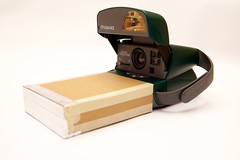


I made a crude box out of cardboard and masking tape for the OneStep Express. Yes, it is ugly and could use refinement, but it works!

After the first pack or so, I was hooked! But I was a little frustrated by the OneStep Express camera, being that it had a fixed focus and sub-par (probably plastic) lens. It's kind of like using a self-developing Holga.

Maybe I should check into getting an SX-70….

Friday, June 4, 2010

RRS Ball-heads arrived yesterday!


I'm excited: Our Really Right Stuff tripod heads arrived! I can't wait to try them out. More to come....

Thursday, May 13, 2010

Canon announce the manufacture of the 40 millionth EOS camera


My wife and I have certainly contributed to that 40 million over the last few years!

LAKE SUCCESS, N.Y., May 13, 2010 – Canon Inc. announced today the achievement of a new camera-manufacturing milestone as combined production of the company's EOS-series film and digital single-lens reflex (SLR) cameras passed the 40-million mark.

Production of the EOS SLR camera first began in 1987 at Canon Inc.'s Fukushima Plant (now Fukushima Canon Inc.), and then later moved to Canon Inc., Taiwan; Oita Canon Inc.; and most recently Nagasaki Canon Inc. from March of this year. In 1997, the 10th anniversary of the series, production reached 10 million units, and in 2003 passed the 20-million mark. After the rapid spread of digital SLR cameras, Canon went on to reach the 30-million mark during the series' 20-year anniversary in December 2007, followed by the current 40-million-unit production milestone, attained after a short two years and four months. Furthermore, the EOS Digital series also recorded a production milestone of 20 million units.

The EOS series, which stands for "Electro Optical System" and also carries the name of the Greek goddess of the dawn, was first introduced in March 1987 as a new generation of AF SLR cameras that incorporate the world's first electronic mount system, achieving complete electronic control not only between the lens and body but throughout the entire camera system.

With the key concepts of high speed and ease-of-use, the EOS-series cameras, including the top-of-the-line EOS-1 professional model, which was first introduced in 1989, and the compact, lightweight EOS Rebel (EOS Kiss or EOS 1000 in other regions), which was released in 1990 and helped to expand Canon's user base, actively incorporated innovative technologies and gained acceptance from a wide range of users. Following the introduction of the EOS D30 in 2000, a time when the spread of digital SLR cameras was in full swing, Canon developed such advanced technologies as its proprietary CMOS sensors and the high-performance DIGIC digital image processor, as well as an extensive lineup of EF lenses in an effort to fulfill the company's new key concepts of high speed, ease-of-use, and high image quality.

Canon further expanded its rich product lineup with the release of the entry-level EOS Rebel T2i (EOS Kiss X4 or EOS 550D) digital SLR camera in February of this year, which features an approximately 18.0-million pixel CMOS sensor and supports an extended ISO range, bringing the total to seven cameras-two professional, three advanced-amateur, and two entry-level models-in the EOS series.

Canon is deeply grateful for all of the support from its customers to make possible this production milestone, and will continue striving to produce innovative and attractive products that deliver all-around customer satisfaction while further endeavoring to create an enjoyable digital photo culture.

Lenticularism!


I read Photojojo regularly, and I found this one pretty intriguing -- Lenticular street art in Berlin.
You have probably seen lenticular printing before, but may not have known what it is called. It's often used on baseball cards, fast-food promotional drink cups, etc., and often depicts multiple images of a subject in motion, such as a baseball player swinging a bat. The image appears to move as your angle of view changes.

This use of lenticularism (is that a word?) is very cool!


Free Aperture 3 Class!


Over on CreativeLive, there is a free course on Aperture 3 each Monday at 6 PM ET available here:
http://creativelive.com/courses/aperture3/

Each part of the course is 2 hours, and the first is Monday, May 17, and ending on May 31. I'm looking forward to it!

It is taught by Scott Bourne, who is a pretty incredible photographer.

Did I mention that the course is free?

Friday, January 8, 2010


Obviously, I stink when it comes to being a regular blogger.....


Saw this today, and got a little happy, since I have a Polaroid 600-capable camera and no film for it....

Tuesday, October 20, 2009

Laforet's Nocturne film available today (u)

(Note: This article has been updated. Working links to the video are in the Update paragraphs.)

Once again, Vincent Laforet has sprung a fantastic video on us created with a new Canon 1080p still camera. Last year's Reverie was done with the 5DMkII. This year, Nocturne was shot with the brand new 1D Mark IV.

But get this: Nocturne was shot at night (as was Reverie), but Nocturne uses only ambient lighting from the streets of Los Angeles. No strobes, no studio lights, just streetlamps and car headlights. At ISO 6400! The lack of noise is impressive.

Nocturne can also be seen here, though it may be a little slower to load.

UPDATE Oct 21: Now, in a bizarre turn of events, Canon Japan has asked Laforet to take down the video. Laforet complied, citing "professional courtesy." But of course, this is the Internet, and the video can still be seen on YouTube.

Why would Canon Japan want to remove high-quality, viral, and free advertising for their flagship still camera? Photography Business News & Forum has some thoughts.

Fake Chuck Westfall has sounded off about it as well.